Marginally improved the Red-backed Shrike portfolio this evening with another visit to Biggleswade Common.


Marginally improved the Red-backed Shrike portfolio this evening with another visit to Biggleswade Common.
Steve Heath discovered this Red-backed Shrike on Biggleswade Common, north of the sewage works, by the railway line. Digiscopers were out in force, but the fear of flushing the bird prevented me form getting close shots with the DSLR setup. The bird seemed settled, mainly feeding on grasshoppers.


After a number of days of easterly winds, the east coast had good numbers of migrant warblers, chats and the odd rarity. Early rain showers put paid to photography at Waxham, and anyhow, the reported Semi-collared Flycatcher was not showing.
A few miles south at Winterton dunes, the light improved and it was fairly easy to get close to the birds by sitting down in the scrub and waiting. A male and female Common Redstart fed to within twenty feet.

This Pied Flycatcher was content to sit in the open.
The Wryneck was a no-show, and the Red-backed Shrike preferred its appreciative audience to keep to a respectful distance.

A juvenile Red-backed Shrike was just outside the reserve viewed from a public footpath along the bank of the Thames.


The current visitors centre will eventually become an educational building. An interesting strucure indeed - my first thought was 'yuk' ! (and remains so).
A Wood Sandpiper was just a bit too distant.
A distant Northern Wheatear.
A few Little Egret were dotted around the reserve.
This Ruff showed well from the hide.

My best view of a Water Vole. This is a top site for these declining creatures.


Roesel's Bush Cricket Metrioptera roeselii. A scarce cricket, mainly found near coasts but increasing inland.
A Migrant Hawker.
A distant shot of the QEII bridge which carries the M25 motorway over the River Thames.
A nice spot, overall, difficult to believe it's not far from busy London.
Little Tern could be seen daily at the salt pans.

White stork feed at the salt pans and nest on suitable stuctures in surrounding towns and villages.

European Bee Eater at the salt pans.


Olivaceous Warbler at the salt pans - miles from its usual haunts !

A male Red-backed Shrike along the track to the 'Goat Pit'.

Yellow-legged Gull over the 'Goat Pit'. This area is not for the squeamish !

Eastern Black-eared Wheatear.

The Crested Lark is common here and approachable.

This Middle-spotted Woodpecker was very shy. It has a bill full of food for its offspring but the nest was well hidden deep in a fenced Olive grove.

This Eurasian Hoopoe was feeding in the same Olive grove. The shot was taken from the car through a chain-link fence.

This Rock Nuthatch posed for a while close to the main road.
A few pairs of Isabelline Wheatear breed at the 'Isabelline Triangle' - an exposed area at a road junction. Not easy to stalk, but one did conveniently pop up on a road sign.
The further west one travelled, the more Red-backed Shrike were evident. Which image to show ? Well, I never did get a shot I really liked, so these two will have to do. 
It's a testament to what we've done to our landscape when you realize that they once bred around Luton.
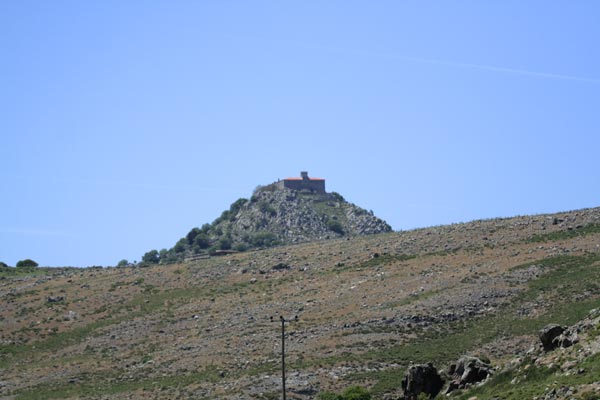
Ipsilou Monastery is a fantastic migrant hot spot - it sticks out in an otherwise relatively barren landscape.
First up was a male dark-throated form of Black-eared Wheatear which was feeding in the small, walled, terraced gardens. It was very warm and the strong mid-day light gave problems with contrast, but it was clearly the eastern race melanoleuca which shows a narrow strip of black above the bill.
I climbed the final set of steps up to the monastery proper. A group of three photographers had arrived and were setting up shop down a track between the buildings and the low boundary wall - a excellent spot I'd watched from on the last visit in 1999. Other than that we were the only people there - except, that is, a mad monk with bad English who really wanted us to look at the museum !
The three stooges had walked past a calling Rock Sparrow just inside the first courtyard. I hung around and took plenty of shots of this very obliging individual. The last time we were here, it was a trip up to the battlements to get brief glimpses as it entered its nest hole.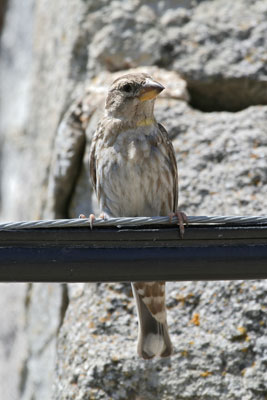
Heading back out of the courtyard I noticed the three lads were snapping away from a prime spot just down the track. I kept my distance out of courtesy - not wishing to disturb anything major. Soon I noticed a hippolais in a tree close to the lads. I could not be specific at this point as is was too far, but it looked to have a classic wing panel typical of spring Icterine Warbler. They were photographing other birds in a tree opposite - again too far to see (had left the 'scope in the car).
After a decent time interval, I joined them and, in my best estuary English, enquired the usual 'much abaht?'. Two Wood Warbler and a bunch of Spotted Flycatcher - no mention of the Iccy. These guys looked respectful - post grad types - perhaps all rounders in the natural world. Then one barked 'large hippolais - it's an Olive-tree Warbler !'. Lo, the bird I'd seen from further back had reappeared - was I seeing things ?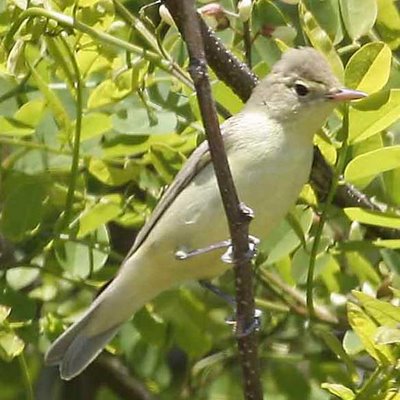
The above shot shows the stout flesh coloured bill and grey legs, peaked crown and pale yellow eye-ring.
The above shot shows the neat pale yellowish fringes to the tertials and inner secondaries forming a distinct wing panel, pale lores and the yellowish supercillium extending well behind the eye. Long primary projection. Email me or post a comment if you know different !
Another male Black-eared Wheatear, this time a pale-throated morph of the melanoleuca race, which posed for a while before going 'over the edge'.